
Scroll down for English
Hysbysiad Archwilio
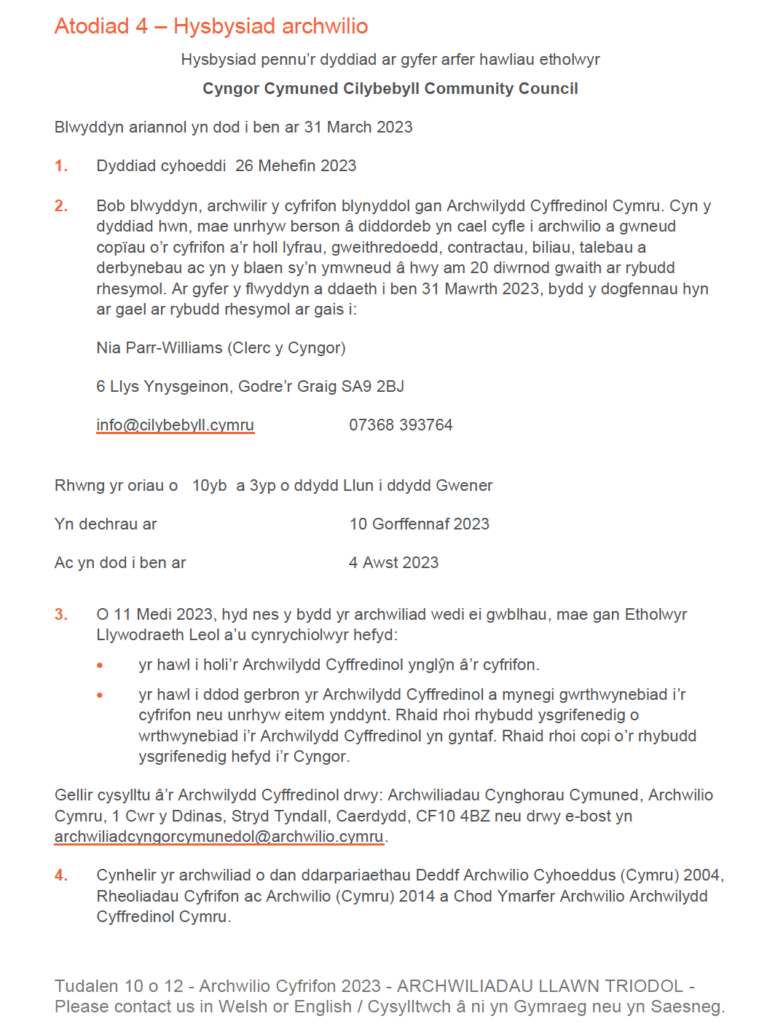
Hawliau etholwyr o dan Ddeddf Archwilio Cyhoeddus (Cymru) 2004
Y sefyllfa sylfaenol
Drwy gyfraith, mae gan unrhyw berson â diddordeb yr hawl i archwilio cyfrifon y Cyngor. Os oes gennych hawl ac os ydych wedi cofrestru i bleidleisio yn etholiadau’r cyngor lleol, yna mae gennych chi (neu eich cynrychiolydd) yr hawl hefyd i ofyn cwestiynau amdanynt i’r Archwilydd Cyffredinol neu i herio eitem sydd wedi ei chynnwys yn y cyfrifon.
Yr hawl i archwilio’r cyfrifon
Pan fydd corff llywodraeth leol wedi cwblhau ei gyfrifon ar gyfer y flwyddyn ariannol flaenorol, rhaid iddo hysbysebu eu bod ar gael i bobl edrych arnynt. Ar ôl rhoi rhybudd rhesymol o’ch bwriadau, bydd gennych wedyn 20 diwrnod gwaith i edrych drwy’r cyfrifon a’r dogfennau ategol. Cewch wneud copïau o’r cyfrifon a’r rhan fwyaf o’r dogfennau perthnasol gan y corff. Mae’n debyg y bydd yn rhaid i chi dalu tâl copïo.
Yr hawl i ofyn cwestiynau i’r archwilydd ynglŷn â’r cyfrifon
Cwestiynau ynglŷn â’r cyfrifon yn unig y cewch eu gofyn i’r Archwilydd Cyffredinol. Nid oes rhaid i’r Archwilydd Cyffredinol ateb cwestiynau ynghylch polisïau, cyllid, gweithdrefnau’r corff na dim arall nad yw’n gysylltiedig â’r cyfrifon. Rhaid i’ch cwestiwn ymwneud â’r cyfrifon sy’n destun yr archwiliad. Nid oes rhaid i’r Archwilydd Cyffredinol ddweud a yw’n credu bod rhywbeth y mae’r cyngor wedi’i wneud, neu eitem yn ei gyfrifon, yn gyfreithlon neu’n rhesymol.
Yr hawl i fynegi gwrthwynebiad i’r cyfrifon
Os ydych chi’n credu bod y corff wedi gwario arian na ddylai ei gael, neu fod rhywun wedi achosi colled i’r corff yn fwriadol neu drwy ymddwyn yn anghyfrifol, gallwch wrthwynebu’r Archwilydd Cyffredinol drwy anfon ‘hysbysiad o wrthwynebiad’ ffurfiol, y mae’n rhaid iddo fod yn ysgrifenedig i’r cyfeiriad isod. Gallwch ofyn i’r Archwilydd Cyffredinol wneud cais i’r llysoedd am ddatganiad bod eitemau o’r fath yn anghyfreithlon. Rhaid i chi ddweud wrth yr Archwilydd Cyffredinol pam eich bod yn gwrthwynebu. Mae’n rhaid i’r Archwilydd Cyffredinol ddod i benderfyniad ar eich gwrthwynebiad. Os nad ydych yn hapus gyda’r penderfyniad hwnnw, gallwch apelio i’r llysoedd. Rhaid i chi hefyd anfon copi o’ch hysbysiad at y cyngor ei hun.
Cewch wrthwynebu hefyd os byddwch yn meddwl bod rhywbeth yn y cyfrifon y dylai’r Archwilydd Cyffredinol ei drafod gyda’r Cyngor neu ddweud wrth y cyhoedd amdano mewn ‘adroddiad buddiant cyhoeddus’. Unwaith eto, rhaid i chi roi eich rhesymau yn ysgrifenedig i’r Archwilydd Cyffredinol yn y cyfeiriad isod. Yn y sefyllfa honno, rhaid i’r Archwilydd Cyffredinol benderfynu a ddylid cymryd unrhyw gamau. Fel arfer, bydd yr Archwilydd Cyffredinol yn rhoi rhesymau dros ei benderfyniad, ond nid oes rhaid iddo wneud hynny ac ni chewch apelio i’r llys. Ni chewch ddefnyddio’r ‘hawl i wrthwynebu’ hon i wneud cwyn bersonol neu hawliad yn erbyn y corff.
Os byddwch yn dymuno gwneud cwyn neu hawliad personol, dylech fynd â’r cwynion hyn i’ch Canolfan Cyngor ar Bopeth leol, Canolfan y Gyfraith leol, neu eich cyfreithiwr. Efallai y cewch hefyd gwyno wrth Ombwdsmon Gwasanaethau Cyhoeddus Cymru os byddwch yn credu bod Aelod o’r corff wedi torri’r Cod Ymddygiad ar gyfer Aelodau. Gellir cysylltu â’r Ombwdsmon yn: 1 Heol yr Hen Gae, Pencoed, Pen-y-bont ar Ogwr CF35 5LJ, (ffôn: (01656) 641 150).
Beth arall y gellwch ei wneud
Yn hytrach na gwrthwynebu, gellwch roi gwybodaeth i’r Archwilydd Cyffredinol sy’n berthnasol i’w gyfrifoldebau. Er enghraifft, gellwch sôn wrth yr Archwilydd Cyffredinol os byddwch yn meddwl bod rhywbeth o’i le ar y cyfrifon neu am wastraff ac aneffeithlonrwydd yn y ffordd y mae’r Cyngor yn rhedeg ei wasanaethau. Nid oes rhaid i chi ddilyn unrhyw derfynau amser na gweithdrefnau penodol. Nid oes rhaid i’r Archwilydd Cyffredinol roi adroddiad manwl i chi o ganlyniad ei archwiliad.
Gair terfynol
Rhaid i gyrff llywodraeth leol, ac felly trethdalwyr lleol, dalu costau delio â chwestiynau a gwrthwynebiadau. Pan fydd yr Archwilydd Cyffredinol yn penderfynu a ddylid mynd â’ch gwrthwynebiad ymhellach, mae un o gyfres o ffactorau y mae’n rhaid iddo eu hystyried yn cynnwys y costau a fydd yn gysylltiedig. Bydd ond yn parhau gyda’r gwrthwynebiad os yw er budd y cyhoedd i wneud hynny. Os byddwch yn apelio i’r llysoedd, efallai y bydd yn rhaid i chi dalu am y camau gweithredu eich hun.
Os byddwch yn dymuno cysylltu â’r Archwilydd Cyffredinol, ysgrifennwch at: Archwiliadau Cynghorau Cymuned, Archwilio Cymru, 1 Cwr y Ddinas, Stryd Tyndall, Caerdydd, CF10 4BZ.
Notice of Audit
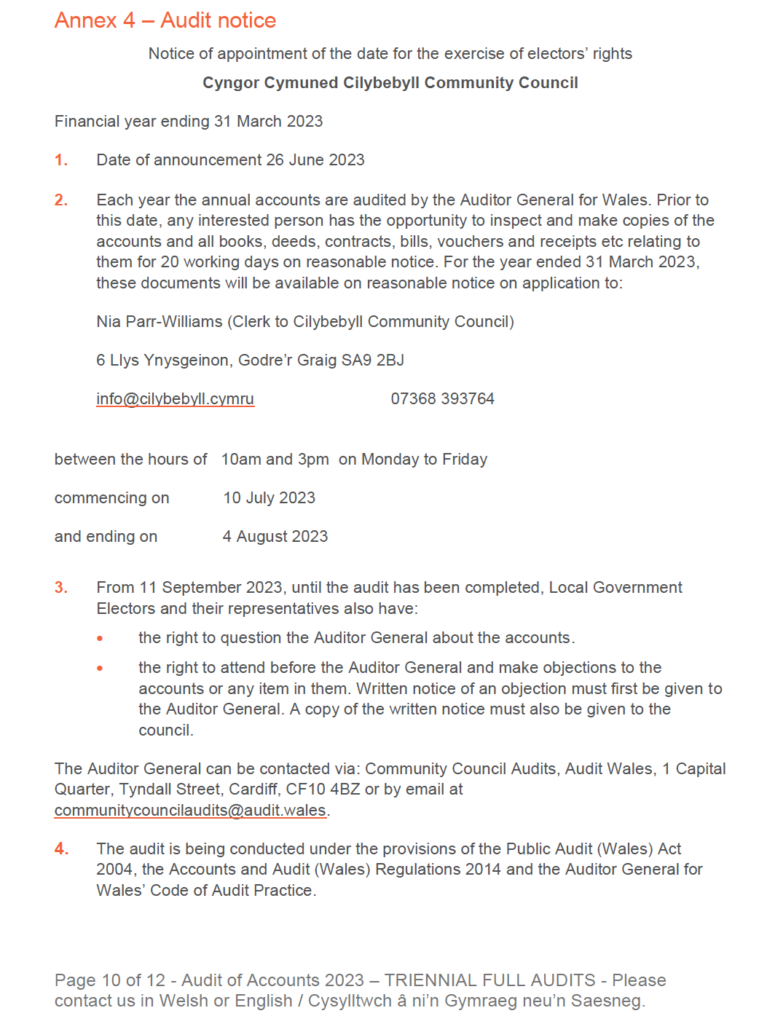
Electors’ rights under the Public Audit (Wales) Act 2004
The basic position
By law, any interested person has the right to inspect the council’s accounts. If you are entitled and registered to vote in local council elections, then you (or your representative) also have the right to ask the Auditor General questions about them or challenge an item of account contained within them.
The right to inspect the accounts
When a local government body has finalised its accounts for the previous financial year, it must advertise that they are available for people to look at. Having given reasonable notice of your intentions, you then have 20 working days to look through the accounts and supporting documents. You will be able to make copies of the accounts and most of the relevant documents from the body. You will probably have to pay a copying charge.
The right to ask the auditor questions about the accounts
You can only ask the Auditor General questions about the accounts. The Auditor General does not have to answer questions about the body’s policies, finances, procedures or anything else not related to the accounts. Your question must be about the accounts that are subject to audit. The Auditor General does not have to say whether he thinks something the council has done, or an item in its accounts, is lawful or reasonable.
The right to object to the accounts
If you think that the body has spent money that they should not have, or that someone has caused a loss to the body deliberately or by behaving irresponsibly, you can object to the Auditor General by sending a formal ‘notice of objection’, which must be in writing to the address below. You may request that the Auditor General applies to the courts for a declaration that such items of account are unlawful. You must tell the Auditor General why you are objecting. The Auditor General must reach a decision on your objection. If you are not happy with that decision, you can appeal to the courts. You must also send a copy of your notice to the council itself.
You may also object if you think that there is something in the accounts that the Auditor General should discuss with the council or tell the public about in a ‘public interest report’. Again, you must give your reasons in writing to the Auditor General at the address below. In this case, the Auditor General must decide whether to take any action. The Auditor General will normally, but does not have to, give reasons for his decision and you cannot appeal to the courts. You may not use this ‘right to object’ to make a personal complaint or claim against the body.
If you wish to make a personal complaint or claim, you should take these complaints to your local Citizens’ Advice Bureau, local Law Centre, or your solicitor. You may also be able to complain to the Public Services Ombudsman for Wales if you believe that a Member of the body has broken the Code of Conduct for Members. The Ombudsman can be contacted at: 1 Old Field Rd, Pencoed, Bridgend CF35 5LJ, (tel: (01656) 641 150).
What else you can do
Instead of objecting, you can give the Auditor General information that is relevant to their responsibilities. For example, you can simply tell the Auditor General if you think that something is wrong with the accounts or about waste and inefficiency in the way the council runs its services. You do not have to follow any set time limits or procedures. The Auditor General does not have to give you a detailed report of the outcome of his audit.
A final word
Local government bodies, and therefore local taxpayers, must meet the costs of dealing with questions and objections. When the Auditor General decides whether to take your objection further, one of a series of factors he must take into account includes the costs that will be involved. He will only continue with the objection if it is in the public interest to do so. If you appeal to the courts, you might have to pay for the action yourself.
If you wish to contact the Auditor General, please write to: Community Council Audits, Audit Wales, 1 Capital Quarter, Tyndall Street, Cardiff, CF10 4BZ.